Simulation infrastructure for physical AI
Trekion rebuilds real facilities as photoreal, physics-accurate simulation. Train and test your robots there before they reach the floor: environments and assets, evaluation, and benchmarking on one pipeline.
Current success rate
86%
Across all validation test cases
Latest checkpoint
Model · Epoch 600
Best success rate
100% pass
from the evaluation workspace
Testing robots in the real world does not scale.
Robot data is never free
Language models trained on data that already existed on the internet. Robot data has to be collected each time: hardware hours, supervision, facility access, or payments to a data provider.
Generic sim cannot be trusted
Simulation is the obvious answer, but stock simulators carry too much sim-to-real gap: game-like rendering, approximate contact, nobody's actual site. A sim you cannot trust returns confident, wrong answers.
Accurate sim changes the economics
Close the gap and the economics change: evaluations you can rely on, run in minutes instead of hundreds of hardware hours, before the fleet is committed.
On hardware-testing cost, Genesis AI has published figures running to hundreds of hours per real-world evaluation pass.
The precedent
Self-driving already went through this.
Waymo has described driving on the order of 20 billion miles in simulation against tens of millions on real roads. No autonomy program has reached deployment on physical miles alone. And driving is the easy version: one body, one road network, one job. A warehouse floor holds many embodiments, many tasks, and none of driving's free data.
A week on hardware
≈ 40 rollouts
An afternoon in sim
10,000 rollouts
Failures get grouped automatically
Failed runs are clustered by cause and ranked by cost, so the pattern reaches you before the footage does.
Generic simulation misses the site.
In published work on forklift perception, a model trained only in a generic simulator managed 49.4% recall on photos from a real warehouse. World-model synthetic data lifted the same task to 84.7% recall. Grounding the data in the actual site, its floors, its labels, its lighting, took precision to 99.5%.
Generic simulation carries you partway. The distance that remains is the site itself, and building that half is exactly what our pipeline does.
Source: SoftServe and NVIDIA with Toyota Material Handling Europe.
forklift perception, real warehouse photos. same task, same model family. figures published by SoftServe, NVIDIA and Toyota Material Handling Europe.
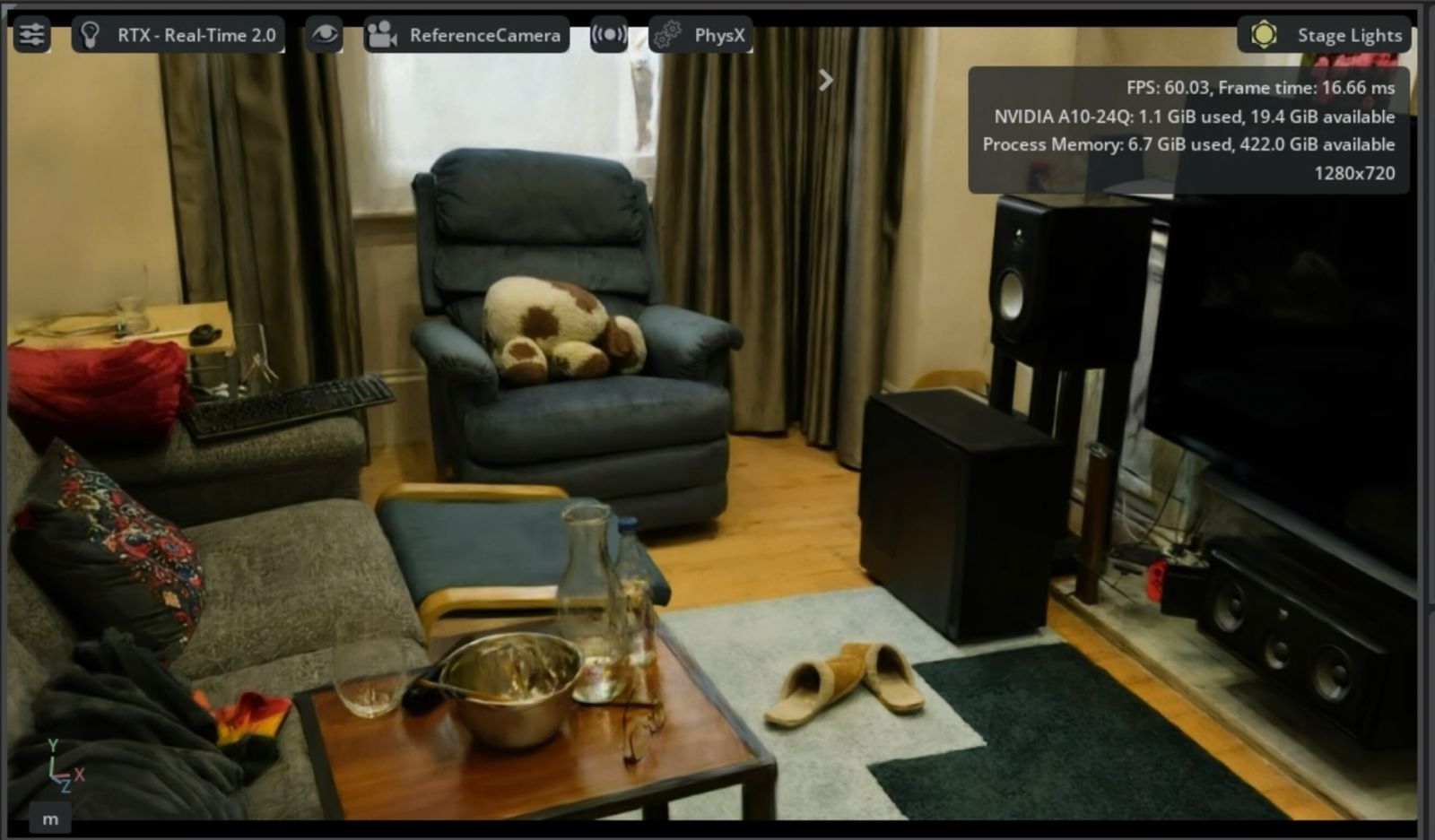
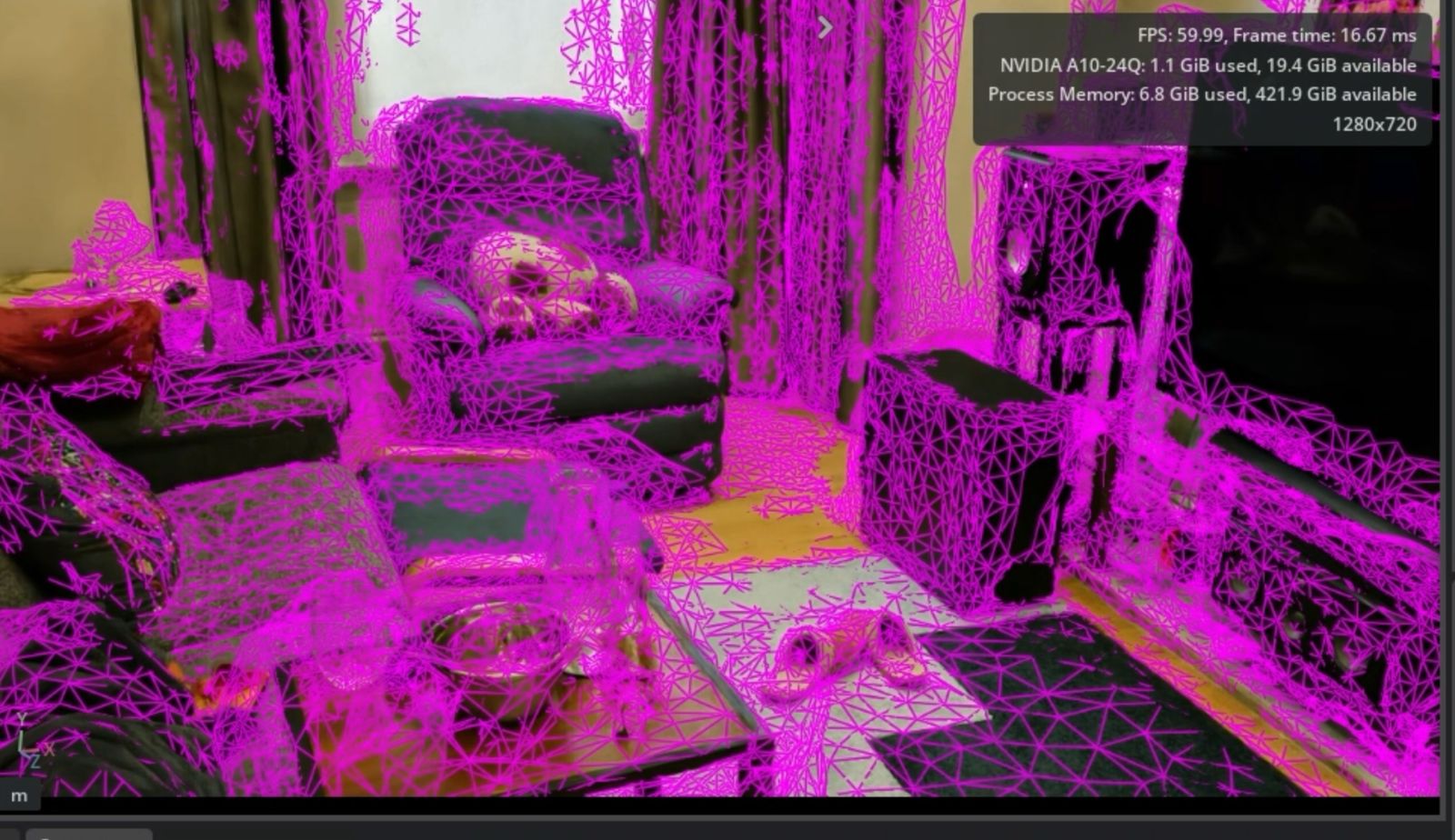
One captured scene, two views.
A room we captured, reconstructed, and loaded into Isaac Sim, rendering in real time at 60 FPS. On the left, the scene a camera would see. On the right, the same scene as the physics solver sees it. Most simulation gives you one or the other. A scene has to hold up as both to be worth testing in.
One pipeline. Three products.
Everything rests on one capability: turning a working facility into a simulation that behaves like it. The environments are what teams buy first. The evaluation is what proves the worlds are honest. The loop is what keeps them that way.
Every run, and eventually every deployment, feeds the pipeline. The worlds get harder to compete with each time they are used.
Working facility
scans, video, floor plans
Real-to-sim pipeline
capture · reconstruct · physics · randomise · report
Assets & environments
Evaluation
Benchmarking
Three products on one pipeline.
Assets & environments
Environments built from real facilities.
Library and generation
A repository of physics-ready assets and environments, plus an LLM-driven interface that generates new ones from a prompt or a spec.
Deployment-specific real-to-sim
Your actual site reconstructed as a photoreal, physics-accurate scene for training and validation before commissioning.
Evaluation
Where a go-live gets signed off.
Scenario-based evaluation
Your policies run against structured suites built from scenarios you define, with subgoal-level grading and failure clustering.
Deployment-environment evaluation
The same harness inside the twin of your specific site, so the report reads like a go-live decision for that floor.
Benchmarking
See where your policy stands.
Against your own history
Every checkpoint measured on identical suites and seeds, so progress and regressions are visible version over version.
Open benchmark
Compare your policies against open-source and custom baselines on the same environments, on one scoreboard.
From a real building to a working simulation.
Capture
The floor is scanned as it runs: layout, racking, surfaces, lighting, and the operating patterns around them.
From the real building
Video, photos, and scans of the live site, not a CAD idealisation.
Hours, not months
Capture-to-scene turnaround measured in hours.
Minimal disruption
No shutdowns; the floor keeps working.
Reconstruct
Neural reconstruction turns the capture into a scene that is photoreal to a camera and solid to a physics solver at the same time. Most simulation gives you one or the other; a scene has to be both to be worth training in.
What the camera sees
Lighting, reflections, glare, and sensor noise a vision stack will meet.
What the solver sees
Collision geometry and articulation underneath the same scene.
Metric scale
Dimensions that survive contact, not just look right.
01Raw capture
video, photos, and scans of the working floor
02Neural reconstruction
splatting into photoreal geometry
03Mesh and colliders
geometry a physics solver can use
04Semantics and scale
racking, lanes, SKUs, metric dimensions
Physics-ready assets
Every object carries measured physical properties: mass, friction pairs, articulation, collision hulls. The SKUs your fleet will actually touch, not a stock library's approximations.
Measured, not defaulted
Inertial and contact properties set from the real thing.
Real inventory
Your pallets, totes, and cages, worn the way they are worn.
Portable
USD, MJCF, and URDF out of the same asset.
every asset ships with measured physical properties, not defaults.
Randomise
The scene multiplies into thousands of structured variants: aisle widths, traffic, lighting, load states. The conditions that end pilots, generated on purpose, usable for training or for evals.
Structured sweeps
Parameterised suites, not random noise.
The long tail on demand
Rare conditions become repeatable test cases.
Deterministic
Same seed, same run, every time.
Aisle congestion
suite: aisle-congestion
Structured variations of aisle width, traffic density, and floor friction across the captured facility.
Environment parameters
Environments (5)
Report
Not a score, a diagnosis. Tasks decompose into subgoals graded one by one, so the report names the exact step that broke and the state of the stack when it happened.
Subgoal grading
Depart, navigate, yield, align, dock, each scored separately.
Failure clusters
Grouped by cause, ranked by what they cost.
Replayable
Step through any episode frame by frame.
Atomic subgoals
Every run improves the simulation.
Field results flow back in. A failure on the floor becomes a scenario in the suite. A success confirms the physics. Checkpoint after checkpoint gets measured against the same conditions, so regressions surface in simulation instead of on hardware.
This is what separates infrastructure from a services engagement: the worlds compound. Each customer run leaves the simulation more accurate than it found it.
nav-2b-sft-v3 leads by 2.5 points. more post-training did not help.
Built at facility scale.
Fleets, congestion, mixed human and robot traffic, and layouts that shift every quarter. Facility-scale problems, not benchtop ones. Research labs rebuild a tabletop; we rebuild the building.
Coverage
Navigate a narrow aisle
Dock to a pallet
Yield to a pedestrian
Handle a blocked lane
Traverse a shift change
Recover from lost localization
Cross a busy intersection
Pick from a mixed rack
Early access.
The pipeline runs today: environments reconstructed from real capture, physics-ready assets, structured evaluation with detailed reports. A self-serve workspace and more verticals are on the way. Access is gated while we work with initial teams.
Common questions.
What is Trekion?
Simulation infrastructure for physical AI. We reconstruct real facilities into photoreal, physics-accurate simulation, run policy evaluations and benchmarks inside them, and feed deployment data back so the worlds keep improving.
How is this different from benchmark evaluation?
Benchmark platforms score your policy on standard task suites. We score it inside the facility it will actually ship to: that site's racking, floors, lighting, and traffic. The output reads like a go-live decision, not a leaderboard entry.
Why does site-specific matter? Is generic sim not enough?
Published work on forklift perception found a simulator-only model reached 49.4% recall on real warehouse photos, world-model synthetic data lifted it to 84.7%, and grounding in the actual site pushed precision to 99.5%. Generic gets you partway. The site is the rest.
Which stacks does it work with?
Scenes and assets export to OpenUSD, Isaac Sim, MuJoCo, and Gazebo. Evaluation is policy-agnostic across VLA and navigation stacks through a standard harness.
Do you need access to my facility?
For a site twin, yes: scans, video, or floor plans. For generated environments, asset packs, and evaluation on our library, you can start without any facility access.
What stage is the product at?
All three products are in early access, gated while we work with initial teams. The pipeline itself, capture to evaluation report, runs today.
Tell us what you are building.
A 30-minute technical call. We will map the pipeline to your stack and put together a sample scene from your spec.
- 30-minute technical call
- Straight to the founders
- A sample scene from your use case